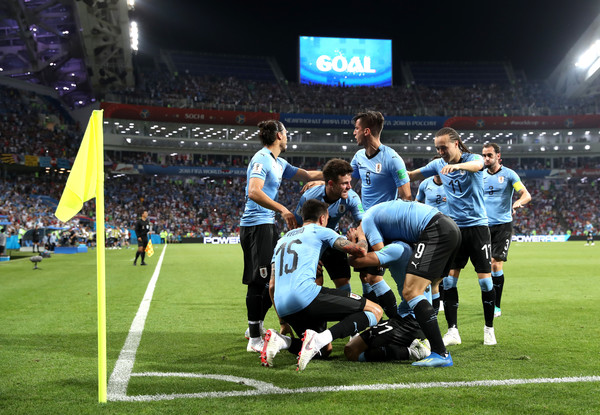
Uruguay has found a winning formula during the World Cup 2018, setting up in “4-diamond-2”. Used on occasion during its qualifying campaign, this system is the one on which La Celeste relied on to get the better of Russia (3-0) and Portugal (2-1) to reach the World Cup quarter-finals.
This article means to suggest how such a game model can be implemented from a coaching and training point of view.
Notes: I have chosen coaching drills that involve a group of players of 16 + 2 or 3 goalkeepers, which corresponds to a realistic session group. These drills are not exhaustive in the training process as a whole, they will of course complement other related drills (games, exercises). However, I chose to propose the drill which seemed to me to be the most able to transmit the desired coaching material. In each process with opposition, there is a target team (in sky blue) and a sparring team. Each team has its own “gameplan”, aiming to generate tactical issues to solve from the target team. I would suggest taking particular care towards the respect of the (any) organisation set, so that it produces match realistic situations during the scrimmage games.
Obviously, this article aims to approach Uruguay’s game plan mostly from a technico-tactical point of view. There’s no recipe for Uruguay’s unique “garra charrua” and it’s not sold in a bottle either. That said, the closest to get to replicate the match intensity through training is to encourage players to do everything right (from finishing clear chances to clearing the ball away when needed – there’s no room for “it’s only training, we’ll do it all right on Sunday”), which is only possible if the training situations they’re involved in make some sense and there’s an account of the score. The smallest details are equally important as the most obvious aspects (do the two teams have a realistic goal, of is the sparring team just human-sized cones, with play stopping on transition). In that sense, simple is often better as far as instructions are concerned, to serve a purpose (with the target team not being constrained in any way). “Situations” are worked on one side at a time, with an identical first pass and player positioning, and shouldn’t last more than half a minute each.
Each drill has been constructed based on a sequence from Uruguay’s games against Russia or Portugal at the World Cup, and the corresponding timecode is mentioned.
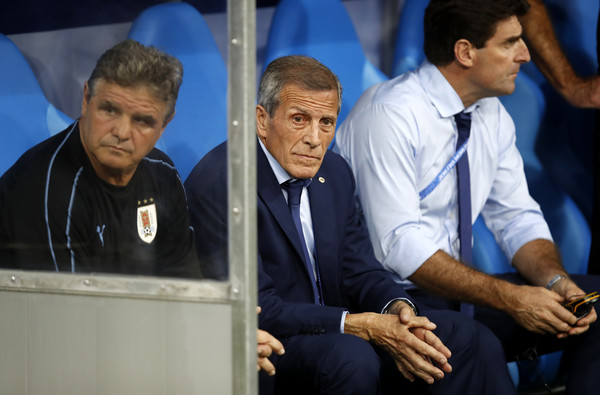
A word about Uruguay’s iconic Oscar Tabarez, who undoubtedly has his share of merit in his team’s success. Uruguay is one of the few international teams that play like a club team, which is without a doubt the best compliment we can make to a national team coach.
Defensive approach:

Uruguay rely on a medium defensive block, which can turn into a low block to soak up pressure (especially when they’re ahead on the score). That’s also a good platform to high press the opposition on specific triggers as well.
The number of Uruguayan players in the centre aims to slow down the opponent’s circuits to play out from the back. Uruguay does not want to be walked on through the middle and will force teams wide.
An imaginary line is set on the defensive third, below of which Uruguay is happy to concede possession because:
- The opponent is not immediately threatening
- If the opponent decides to play long, the Uruguay boasts the near certainty of winning the aerial duel. It’d happen at good enough distance from their box, so that anything random (lose ball, foul) wouldn’t be much of a threat as they’re a capable team in defending their goal on crosses and set pieces.
This uncertainty disappears beyond this imaginary line because a long pass would then drop too close to the box. In this sense, the two strikers’ job is to block passes between centre backs and centre midfielders in order to invite them to play in the sides, or to close them down when they start aiming for a long pass. Attackers cover to anticipate a “CB – opposite FB” pass or “CB – opposite CM” pass.
The attacking midfielder’s role is crucial, he must work in between the opposition’s deepest midfielders to prevent the ball being played back inside.
Once got past by the ball, the ball-near strikers closes the back pass from the fullback to his nearest centre back.
Once the opposition’s fullback is in possession, Uruguay’s side centre midfielder closes down in a specific manner so that the ball is funnelled wide, in where Uruguay aim to get the ball back. The ball far side centre midfielder need to cover his team mate. That pressing trap involves the fullback who’s stepped up to close the winger down to keep him back to goal or stepping ahead of him to intercept the pass.
The deep midfielders’ role is crucial, as he’s tasked to cut the pass toward the opposition’s striker. Otherwise, allowing the opponent to find his striker would put both centre backs into trouble. If the opposition plays with a central attacker (second striker), then the deep midfielder needs to handle him in his zone but give over the responsibility to a team mate if he leaves his zone, so that he always stays between the ball and the goal.
Then the back four’s responsibility is quite standard, they all try to face play at all times and manage space in behind them. Uruguay back off in their own half and wait for defensive overloads before attempting to get the ball back.
The utility of the 4-diamond-2 to pounce on the opponent’s turnovers
To generate attacking transitions, it’s common sense that a team needs to be organized collectively and have players able to recover the ball. Once said, the utility of the 4-diamond-2 in these situations is to have three players in the middle of the attacking half, often already behind opposing midfield line – and in an ideal position to take on the last defensive line.
Defensive game plan: always keep the opponent in front of you
The attackers slow down the build-up
The game below is supposed to be free-flowing, it’s a good warm-up game at the beginning of the session.
However, the coach must ensure that the structures are respected in order to generate realistic tactical situations. Red team are sparring partners, in a 3-2-3 system so that there’s a realistic situation across a back three and two deep midfielders.
- Strikers (9 / 21) isolate the opposition’s two CMs and cover each other (specifically for a cross field pass from CB to fullback, or CB to ball-far CM) to force the pass being played wide.
- If CMs opens up wide, strikers need to protect the central band of the field (between ball-goal)
- Strikers only close down in final third on trigger (underhit back-pass, poor first touch…). Final third is just a general reference point for the players, you can use flat markers.
- Attacking midfielder (6) makes sure to keep the ball-near centre midfielder in sight, and only turn pace to close him down during the pass (and not stick to him early, otherwise he’ll get toyed with and the pass will go elsewhere).
- Once strikers are bypassed (and oppositions fullback is in possession), they need to close the FB-CB back pass.

In this sense, there is a reflection to be carried out on the “football dynamic” which is that the defenders and attackers swap when their team has the ball (when the ball Crosses the middle in combination play). Either this creates a time of readjustment with the ball (keeping it on the move whilst everyone gets back in position), or this involves all players in turn in two areas of play (which is also something interesting with younger 11-a-side age groups, to experience both being the front players to press, or the deepest).
Midfield diamond sets-up the pressing trap wide
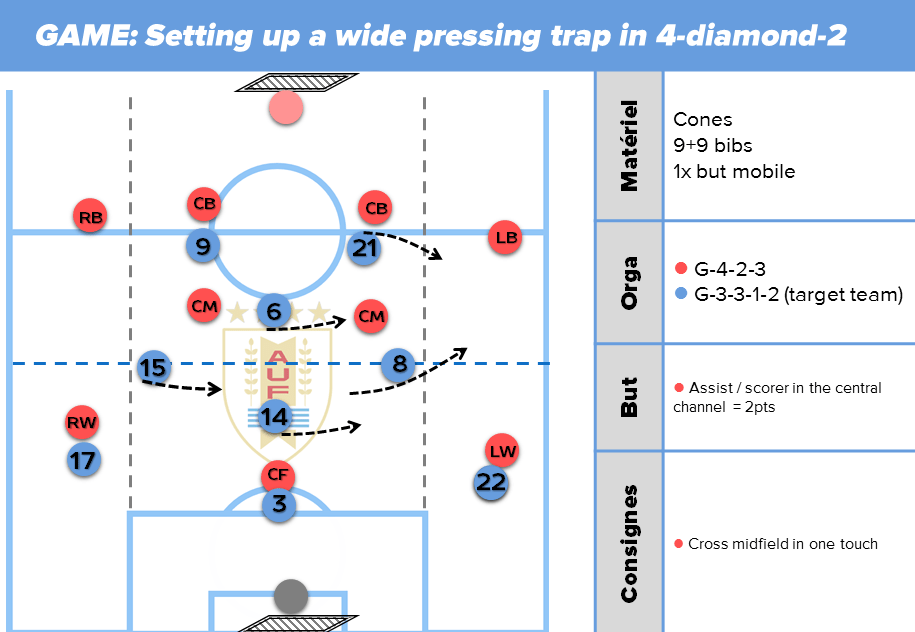
The previous game aimed to coach attackers against the ball. This one aims to coach the midfield four, so that the opponent is forced to play the ball into a trap in wide areas which it will be difficult to get out from.
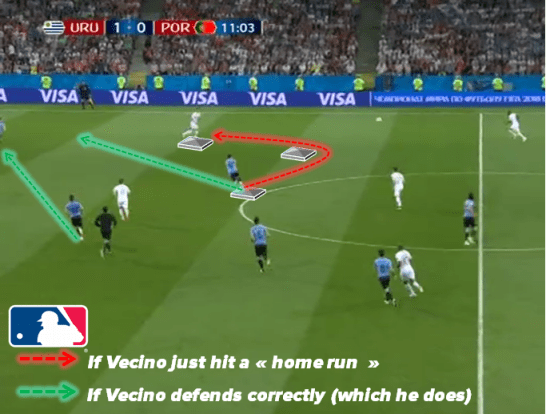
Most important thing for players sliding is not to run crazy like for a baseball “home run”. Many midfielders do that because they’re ball-watching, it takes some time to make sure the path is correct. It saves a lot of energy (which is key in 4-diamond-2) and helps to cover the direct route to goal.
This is a 9v9 game with organisations akin to replicate match dynamics.
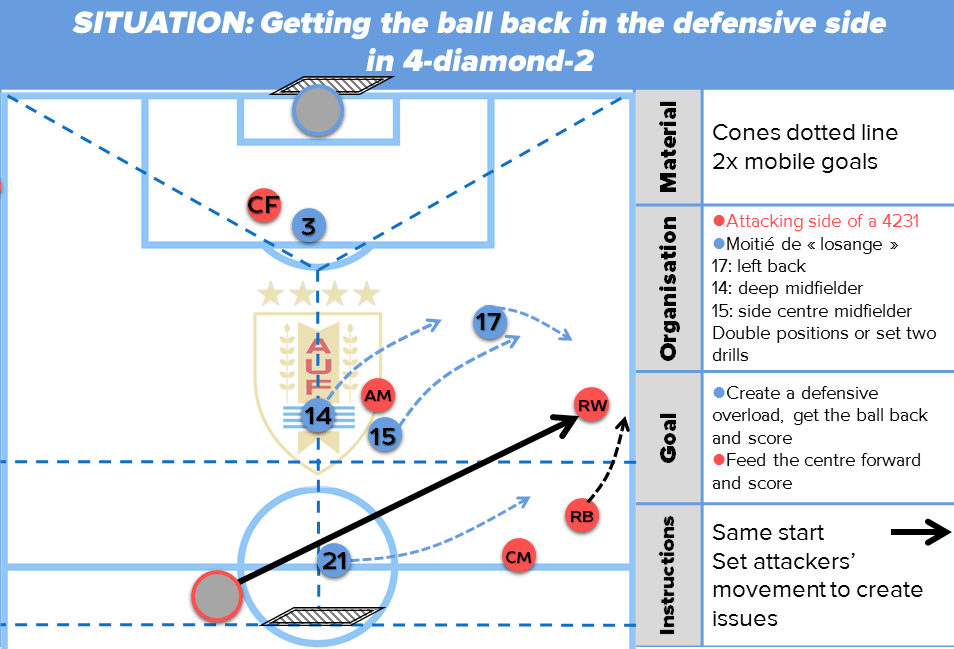
- Once the opposing fullback has the ball, (21) closes the back pass option. (6) gets close to opposition’s CM (“stealth-y”, if he rushes on him, there’s no way any half decent fullback will play the ball on an already marked player). (9) covers the ball-near striker (21) and keeps an eye on any potential brain fart (square flat pass toward the ball-far CM).
- (8)’s role is key to force the ball being played out wide. He needs to block off completely the inside pass option with his body angle, and let the forward pass to the winger open (not stand in between the two, nor try to intercept).
- Ball-far CM (15) needs to cover the ball-near centre midfielder (and not the deepest midfielder (14). He needs to be in position to close down at the far-side if the opponent can switch the ball, sticking too close to (14) would make it difficult to press effectively whoever gets the ball on the opposite side. It’s good to instruct the side CM to not tuck inside beyond the near post.
- In that meantime, the fullback (22) is ready to close down the winger, keep him back to goal or if possible, get in front to intercept (be careful not to be turned out by the winger).
- (14)’s role is key and is based on the opposition’s organisation. One or two strikers, attacking midfielder… He needs to block off any potential pass that could reach an opponent’s striker 1v1 with the target team’s central defender. Meaning that if the player roaming in his zone gets away, he still needs to protect his zone (and hand over the marking duty to someone else).
That can be worked on more accurately with the following “situation” which is a 3v4 with a delayed 4th player joining in defensively. Situation ends on both goals. Centre forward and centre-back (3) aren’t involved at first. If the striker can be reached, it would mean that (14), (15) and (17) haven’t screened or closed down time/space correctly. But it allows the situation to end up in a realistic way.
Goalkeeper replicates a switch to the right winger with RB ready to overlap. The same coaching points as below apply.
Defenders manage the defensive line’s depth and play the offside trap
The back four, specifically the defensive leader is responsible for the height of the defensive line. They’re spread out on the width of the penalty box. Moreover, their body positioning is so that they’re ready to run in both directions (not flat footed).
Considering the opponent is forced to play the ball wide like it’s been set previously, from time to time the side centre midfielder (8) can be out of position and (22), (2) and (14) are left on their own with space in behind, in that situation with a fullback on the overlap.
- Someone shall be accountable for the height of the defensive line. Uruguay’s leader is Godín (3). Principles are basic “ball covered/not covered” to push up or drop off. The more frequently defenders check their shoulders and scan, the better.
- Reference point for the offside trap is the edge of the box.
- Fullback (22) needs to take care of the player running in behind (whoever this is, CF or LW)
- Centre-back (2) must delay his run towards his goal (move in “S”) to put the attacker offside.

Everyone is involved in dealing with crosses.
Sitting deep invites the opposition to cross the ball, hence why it’s crucial to have reliable defenders to defend the box in that type of situation. Uruguay are reliable dealing with those situations because they’re aerially dominant and clear everything before it bounces in their own half. Moreover, everyone is “connected” (already on the move when a close team mate attempts to clear the ball in their direction).
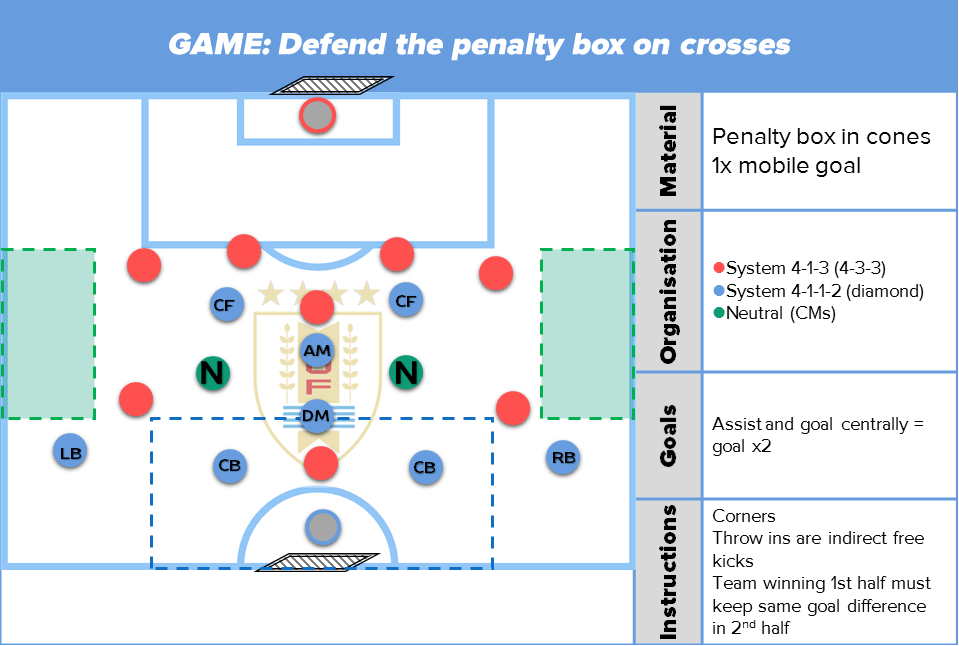
The next game is a good end-of-session game on MD-1. Neutral players are both teams’ CMs, so that the ball is quickly spread out wide and it encourage crosses being put in.
- Invite clearing away the ball towards the green side areas on the side of the incoming cross, for a striker who gets where the ball drops (for full-field, aim for the T between the touchline and midway line). That usually gives a team much needed breathing air, furthermore, it’s frequent that fullbacks make a rash and unnecessary foul there.
- Fullbacks must to try their best to block crosses.
- CBs need to protect the near and far post in the 6 yard box, and end there (not start from there). More or less like strikers are taught to get around the penalty spot before attacking to the near post, taking a step back to attack their zone with momentum is good for defenders too.
- On crosses situations, there’s supposedly a 2v2 to deal with the player who puts the cross in (fullback and side CM), therefore it’s Uruguay’s DM who is tasked to cover the space in between centre back and fullback.
- In a deeper situation (back four inside the box), it’s the side CM who needs to try to block the cross, whilst the DM has to roam in the D to clear away any average clearance. It is important to clear danger first, then try to find a team mate. In the latter case, it’s crucial every player around the one who tries to flick the ball is already on the move (whether it’s the DM if the CM is outjumped, or the striker if the CM wins his duel). Winning second balls is about anticipation.
Attacking gameplan: involve the defensive line on its whole width and depth
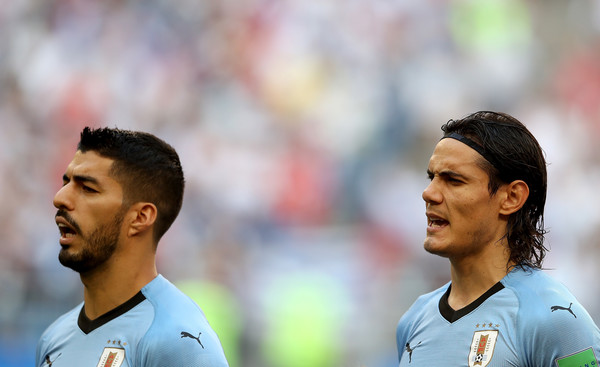
Uruguay’s attack is based on a carefully layered positioning inside the opposition block. Options are in behind midfielders, or defence. You won’t often see Uruguayan players showing for the ball in zones they’ve no business being in (especially in front of opposition’s midfielders). Uruguay’s forward combination play happens in the sides because it’s less risky, half the team (vertically) is still in position behind the ball at the far side.
Centre backs’ circulation is based on what Godín and Giménez can and can’t do, ball circulates across the back at good distance to find someone on the sides. Both options are possible:
- side centre midfielder dropping off and opening up so that the fullback can push up in the vacated space.
- fullback dropping off (having started from a higher positioning) to open up the attacking wing (for a CM or striker to run wide).
Most of the combination play relies on “1-3-2” link up, often trying to find and anchor point to lay off to someone facing play (or flicking on for a runner). The general idea is to break the opponent’s defensive cover by forcing opponents to rush out from their zone, so that it opens up space behind them.
Modern centre back pairings aren’t used to face two strikers willing to run at or behind them, which is what Uruguay can do with Suárez and Cavani. Moreover, having the two of them in sight doesn’t guarantee control of the box for all that, because someone running from deep (Bentancur – 6) or a late run from midfield is another option to pack up the box on crosses.
Opponents are usually in trouble dealing with “4-diamond-2” unless there’s a match specific gameplan to match it.
- Narrowing the back-four to restrict channels to run into only creates an imbalance in midfield with one of the four diamond midfielders free to operate (in front or behind a standard midfield line).
- Trying to aggressively close down side centre midfielders with fullbacks can put centre backs to roast, being 2v2 against the strikers.
Therefore, it is frequent that opposition’s fullbacks are caught in no man’s land, too far to close down the side CM and leaving space in behind them for a striker to pull the CB out of his comfort zone.
Coaching the two strikers in 4-diamond-2 is very interesting. You can encourage both strikers to stay within 20 meters from each other (basically half of the width of the penalty box) unless they can switch the ball like Cavani does (or if a midfielder has the ability to run into the box consistently).
Inbalance the opponent: create anchor points to find runners in behind
The fascinating side of coaching is also to help players read the game better. Game intelligence is about prioritize the correct information available to players to enhance decision making. The coach must dissect the game in order to create learning situations that stem out of it, to put his players abilities in roles they can fulfil.
It’s a case of “if that happens”, “then you can do this or that”; with emphasis being put on reading information you don’t have control on in football, which is how the opposition behaves.
As we’re looking at how to coach some of Uruguay’s attacking movement, then we need to help the players identify how the opposition is dealing with them from a defensive point of view. The focus will be on identifying which and where players are closed down (subsequently, where the space is), and the resulting combinations that can be created out of it.
The idea is to create a “decision tree” in players’ mind that quickens their decision making. This is an example of a decision tree involving the opposition’s fullback and centre back (which corresponds to the areas where most of Uruguay’s attacks happen), with their possible behaviour (closing down / not closing down). From this results a set of options for the attacking players:
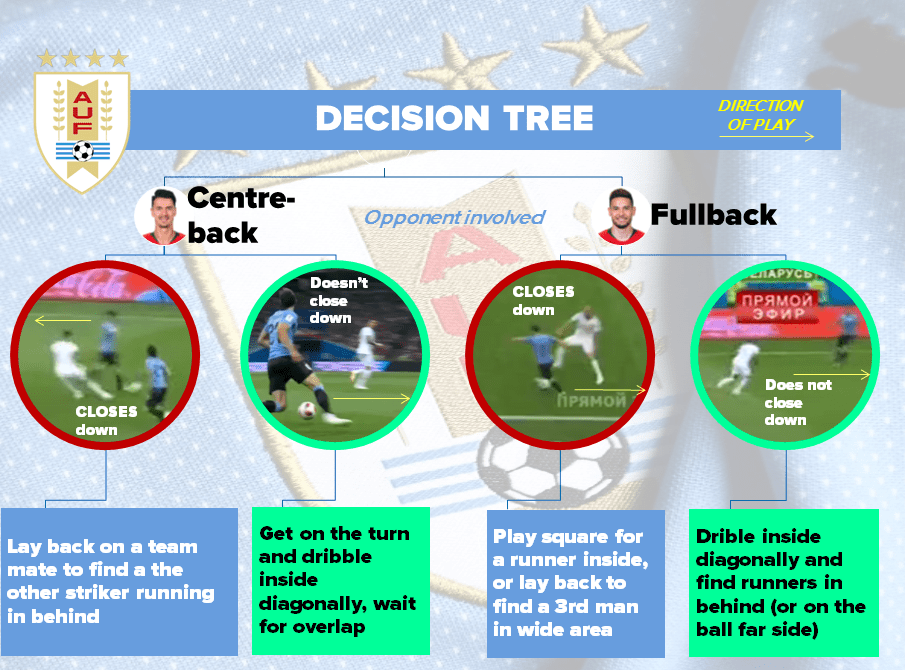
For example, in the situation on the left-hand side: if the centre back (Fonte) closes down the forward (here Suárez), it means that he’s come out of his defensive slot so that there’s space to attack. Suárez can then lay the ball back so that we can find Cavani with a pass in the space Fonte just vacated.
Here’s a quick set of combinations:
- Centre back closes the striker down:
a lay-off for someone facing play will allow to play a first time pass over the top for a third man coming from behind (or the other striker). Third man trigger being the pass to the striker back to goal (and not the 3rd man’s first touch which is too late).
- Centre back doesn’t close the striker down:
striker can turn and/or dribble diagonally. Second striker can run in between the defenders to get the ball outside the CB. Or side centre midfielder can overlap.
- Fullback doesn’t close the striker down:
striker can dribble diagonally inside, whilst the side centre midfielder or fullback overlaps. Striker to attacking midfielder can allow to spread the ball to the overlapping player. Other situation: attacking midfielder running in behind can drag away an opponent or being an option to be found behind the defenders. Lastly, a near post run from the other forward can allow to switch the ball to someone on the far side.
- Fullback closes the side midfielder down:
Unless the striker pairing includes a winger (think Cuadrado vs England, Mbappé for Monaco), strikers don’t naturally show for the ball wide to cut inside like Cristiano Ronaldo used to do for Manchester United. The most frequent situation will then be that a side centre midfielder pins a full back, and creates space in behind. But once that space is vacated, strikers who like to score goals don’t do selfish runs toward the corner flag, and central attacking midfielders are often the reason why teams play 4-diamond-2 (and don’t naturally drift wide, it’s often the opposite nowadays). As far as Uruguay is concerned, Suárez does that type of corner flag run from time to time – and often gets the ball. Which leads to Uruguay’s top striker putting a cross in (which may not be an optimal situation on the right for an easy to defend out swinging cross).
This is the corresponding coaching drill. You need to coach the red team so that they adopt a match-realistic defensive attitude to defend the big goal, whilst the target team must to be guided towards the movements you want to get from them (based on their ability and natural movements).
Sometimes, defence is better organised in training than in official games. Therefore, it’s always possible to ask one of the defenders to make a rash defensive decision (such as being caught in between two), because that tends to happen in games too (here comes the coach’s input again, to identify what frequent defensive mistakes teams do against yours).
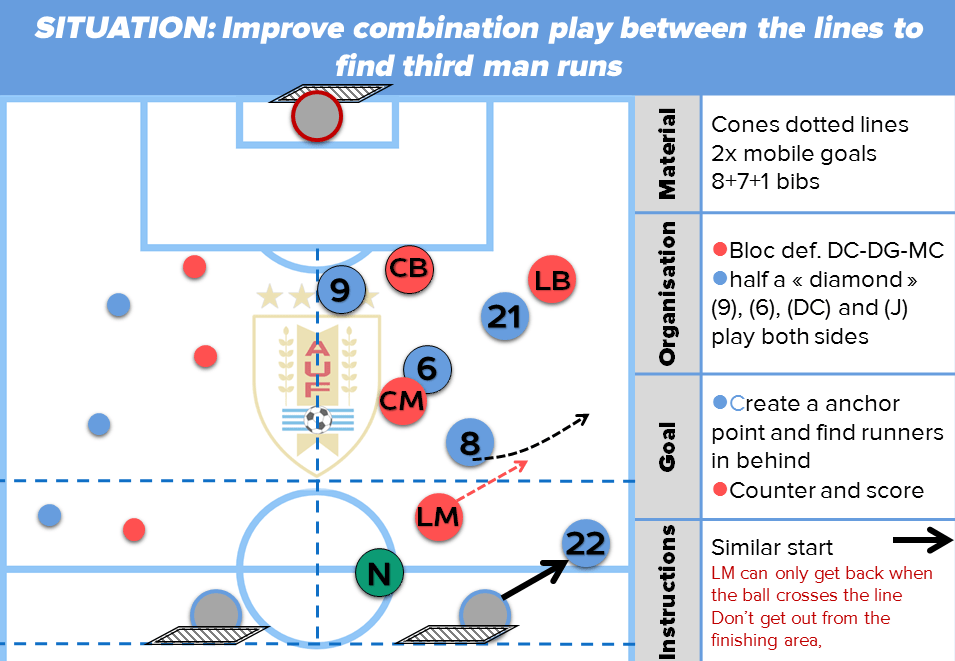
The coach must think in terms of creating and exploiting space. In that set of situations:
- Space can be created by pulling a marker away from his zone, with a run off the ball.
- Second option is to show for the ball back to goal, which in case the defender closes down from behind (he’s “pinned” as far as the attacker back to goal doesn’t give the ball away cheaply), there’s an opportunity to directly exploit the space in behind with a quick one touch “up-back-through” movement.
Having players on the move with a specific set of runs allows the team to be one step ahead of the opponent. It has to be said that creating space is a selfish move for the benefit of the team, meaning that it’s a challenge from a coaching point of view to commit players to do something they won’t immediately benefit from.
Third man runs aren’t too much of a challenge to coach, but sometimes the coach must mechanise certain “unnatural” movements through pattern play (such as an attacking midfielder making a third man run towards the corner flag).
Build-up: create space behind midfielders from the sides, to create anchor points.
Uruguay like to find long diagonal passes on the ground for their strikers. Then, after a lay-off or a flick, they can find runners in behind.
The following pattern play can be worked on with unopposed drills, which will only be of value if it’s done after the previous “situation” that has made players reflect about their own action, so they’re aware of why they’re doing it. Also, each point must be taught with a high level of detail (especially the timing aspect).
The point here isn’t to open the “opposed/unopposed” debate. Badly coached drills are bad, many coaches (most notable in recent years being Antonio Conte) still have a heavy emphasis on analytical drills like this one (to complement other games/situations), let’s not have the pedantry to pretend these coaches don’t know what they’re doing (or that they were only carried by player quality).
The better the players (ie: quick decision making, creativity and technical ability), the more the first kind of drill (situation) will prove of good use. The less skilled players are, the more the latter might be of use in a result-oriented environment. But nothing is ever set in stone and the switch can obviously be adjusted over time.
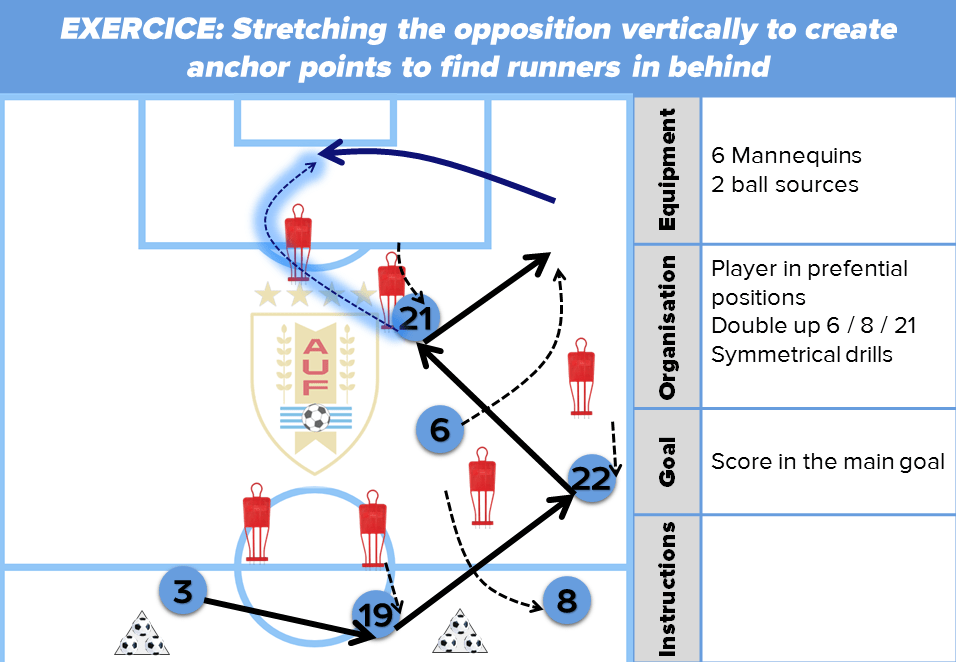
The following unopposed drill is one possible combination that can happen in the previous situation.
- Two centre backs circulate the ball, (3) having pushed up a bit so that it has created space for (19) – because the ball far striker covers his team mate
- During that pass, the side CM (8) opens up backwards toward the touchline, which allows to find (22) higher up. The aim to this is to create an issue to the opposing wide player. Does he sticks with (8) and thus creates a vertical gap behind him, does he stick with (22) and creates an horizontal gap between him and the rest of his team (supposing the shifting isn’t optimal from the opposition).
- (19) jumps to (22) with a mid-length pass on the ground (back foot first touch). On (22)’s first touch, (6) makes an angled run toward the side.
- CF (21) shows for the ball. The quality of (22)’s pass is key, it has to be well hit, possibly with a bounce so that (21) can flick it on the half volley.
Finishing: getting the centre backs busy to find a runner in behind
One of the definite pros of playing with two strikers is to involve half a standard back four to defend, may it be both centre backs or a centre back and a fullback. Meaning there’s room to overload different areas as well, pouncing on two kinds of issues for a defence:
- Dealing with everything happening ball-far; because so called “modern” fullbacks (usually former wingers) are not one hundred percent reliable as covering the far post on crosses (or can be outjumped with momentum).
- Also, having two strikers on the move plus one runner from midfield (central attacker or side centre midfielder) forces the opponent to communicate, and/or it destroys the defensive structure close to the box.
Uruguay produced a different set of situations throughout the World Cup:
- Both strikers coming to the ball-near area, with central attacking midfielder Bentancur getting inside the box (“overlapping them”) from midfield. Russia struggled with this, with Zobnin unsure he had to track him or if Ignashevich had to pick the runner up. Unfortunately, Laxalt’s cross ended up on Akinfeev (40th minute against Russia).
- Strikers on two opposites sides of the pitch, with Cavani playing a diagonal pass with Suárez. Bentancur once again gets into the box. The run Cavani does behind Guerreiro before heading his exceptional goal inside Portugal’s net (6th minute) is a textbook example for strikers: be seen good side, then get in the defender’s blind side to change pace and attack the zone behind him.
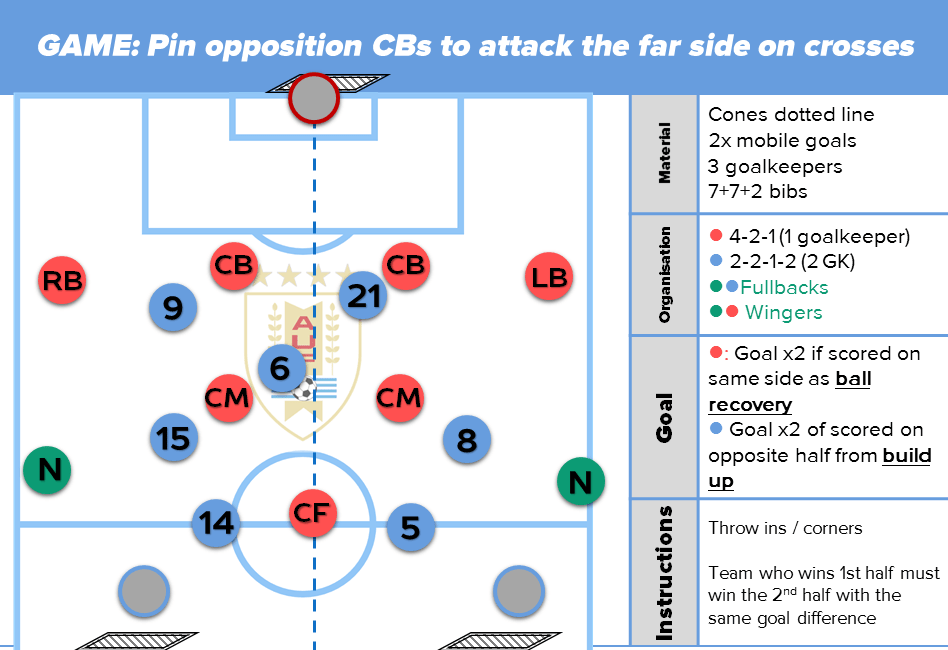
The following game is ideal to work on delivering the ball into the box, as each team has two wide players unmarked (fullbacks for the target team). Two teams don’t have the exact same goal, the target team attacks the big goal (and goals are doubled if they’re scored on the opposite side of the pitch), whilst the sparring team has two goals to attack (with a goal doubled if it’s scored where the target team is building up from). This to naturally create density on one side and keep the game fun, dynamic and straightforward.
Set pieces
The above game to defend crosses is a very good way to work on set pieces in a dynamic manner. Coaches know how working on corners unopposed can be extremely boring for players, or frustrating when they’re handed the wrong bib colour on the eve of the game.
Having every throw-in played like a free kick puts players under pressure to get organised quickly (and stop moaning).
Another variation, even more set-piece specific is to start a designated team with having a free kick. If the free kick is scored, then the team has a penalty. Each corner is taken twice. If a team scores from a corner, they get a free kick wherever they want.
Uruguay’s combination on attacking corners goes as follows:
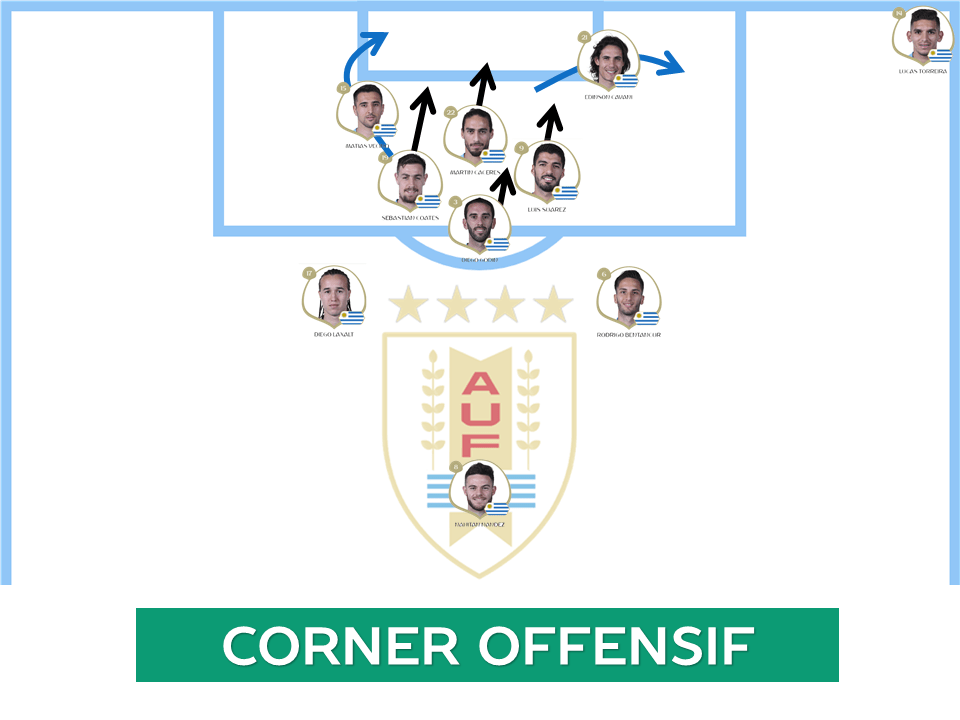
Cavani is the “starter”, he rushes outside the penalty box to get a flick (and pull the near post defender out). The whole world knows Cavani does that to vacate space for Thiago Silva at PSG (yet they still manage to score goals this way). Starting at the same moment than Cavani is the player tasked to tap-in the ball at the far post. They can start from the middle of the field then go in opposite direction (each one doing half an ellipsis).
Then Uruguay have three or four players attacking the goalmouth, who start from the penalty taker’s foot-before-last footing.
They usually defend 2+2 at the edge of the box (against notably terrible on set pieces Russia, they even left only one behind with two including Laxalt, scoring from a volley, at the edge of the box). The two players at the edge of the box are small dynamic attackers, who’re tasked with tactical fouls opponents (the highest on the pitch, the better). Obviously, if one of them is already booked, he may switch with one of the two starters.
Sébastien Chapuis (@SebC__)

 Sébastien Chapuis